

Some truths in life are so commonplace that we never question them. Potatoes are one of them. From childhood to the present day, we’ve always assumed that white potatoes and sweet potatoes are simply different colors of the same family. But one ordinary evening, this belief can quietly shatter.
Imagine this—after a tiring day, you’re standing in the supermarket. You quickly grab a packet of “mixed potatoes” and head home. Upon opening the packet, you find some dull, dirt-covered white potatoes alongside bright, orange sweet potatoes. The name is the same, the packet is the same, but as soon as you peel them, the difference becomes clear.
Their aroma is different. The feel in your hand is different. Their behavior in the pan is different. At that moment, the question arises—if they are truly the same, why are they so different?
How the name deceived us
Our minds automatically categorize things that share the same name. The word “potato” does just that. In stores, they are placed together; in recipes, they are often used interchangeably; and in conversation, no distinction is made.
But this name is actually a linguistic convenience, not a scientific truth. Historically, when European travelers encountered new roots and vegetables, they associated many of them with familiar names. The sweet potato fell victim to this same misconception.
This is how a misunderstanding persisted for generations.
The straightforward answer from botany: They are not related.
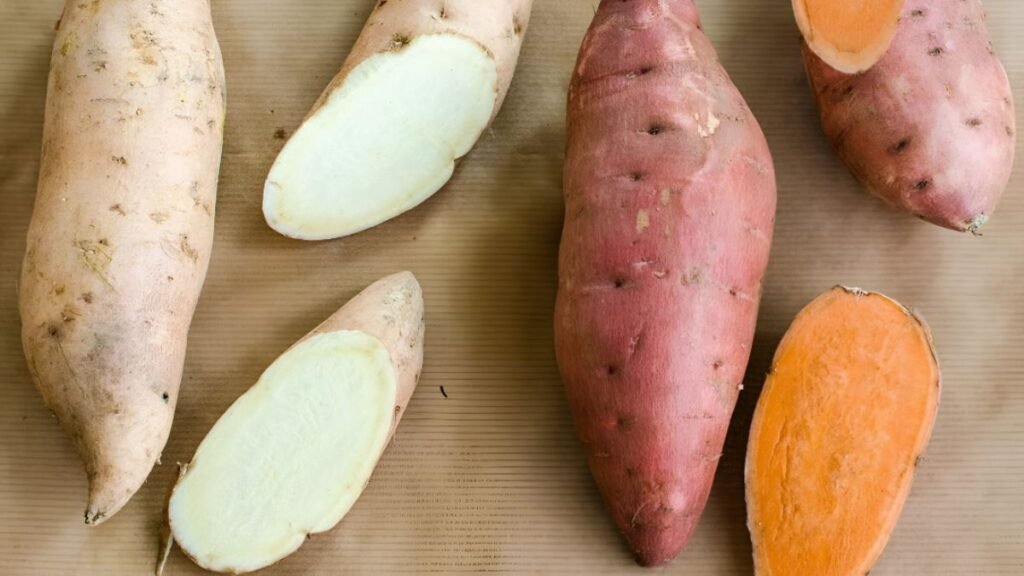
Science states very clearly—ordinary potatoes and sweet potatoes are practically strangers.
The ordinary potato belongs to the nightshade (Solanaceae) family. Tomatoes, eggplants, and peppers also belong to this family. This is why the green parts and sprouts of potatoes can sometimes be harmful. Sweet potatoes, on the other hand, belong to the morning glory (Convolvulaceae) family—relatives of the vines that bear beautiful flowers in the early morning. This difference isn’t just confined to textbooks; it’s evident in their fields, flowers, leaves, and growth patterns.
If you were to create a plant family tree, these two would be found on completely different branches.
The Difference Between Root and Stem: The Inside Story
The part we eat is also different in both. A regular potato is actually a stem that thickens underground to store energy. A sweet potato, however, is a root that stores food for the plant.
This is why their texture, moisture content, and cooking characteristics differ. This is why regular potatoes don’t fall apart when boiled, while sweet potatoes become soft and sometimes sticky.
This difference might seem small, but in the kitchen, it completely changes the flavor.
DNA Completely Dispels the Confusion
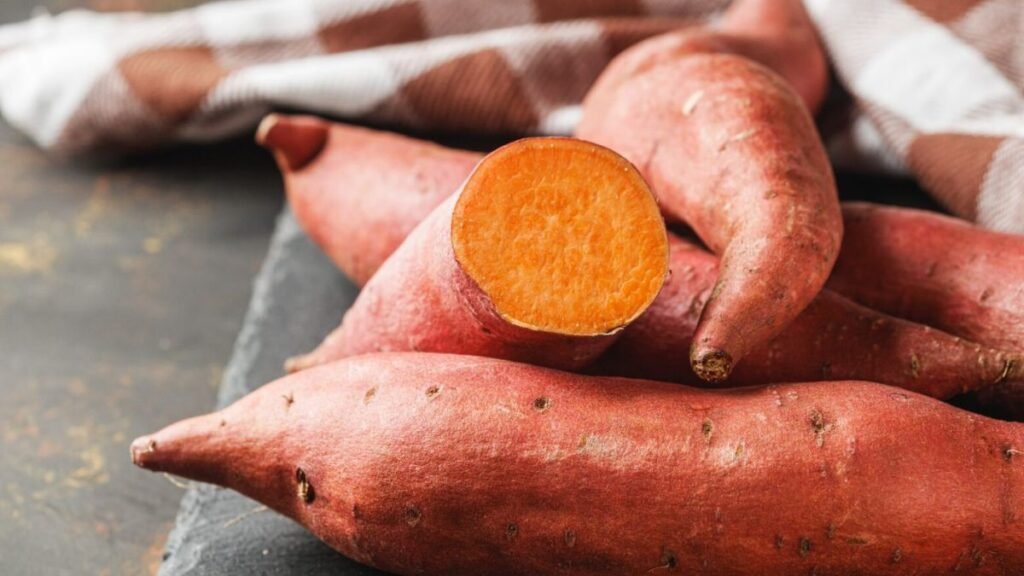
Modern science, through the study of DNA, has put the final nail in the coffin of this misconception. Research shows that the ancestors of regular potatoes and sweet potatoes diverged tens of millions of years ago.
It’s not that they are distant cousins—they are practically plants from different worlds. If a comparison is needed, it would be more accurate to say they are “look-alike strangers.“
Having the same name doesn’t create a biological relationship, and DNA provides the most conclusive evidence of this.
The Truth Comes Out in the Heat
When cooking, science speaks for itself. Try roasting both in the same oven tray.
Regular potatoes will be dry and crispy on the outside and light and fluffy on the inside. Sweet potatoes will look glossy, their edges slightly caramelized, and they will have a natural sweetness.
This difference is because regular potatoes are starch-dominant, while sweet potatoes are higher in sugars, fiber, and beta-carotene. Heat transforms these components in different ways.
Nutrition: Not Better or Worse, Just Different
Sweet potatoes are often touted as a “superfood” on social media, while regular potatoes are labeled “unhealthy.” This is only a partial truth.
Regular potatoes provide energy, are filling, and are a good source of several vitamins. Sweet potatoes are beneficial for eye health, immunity, and fiber.
It’s wrong to consider one a substitute for the other. They serve different purposes, and the body utilizes them differently.
Why Kitchen Wisdom Matters
When we try to substitute one for the other, the results are often disappointing. Sweet potato fries tend to be soggy, and sweet dishes made with regular potatoes taste bland.
Understanding which potato is best suited for which purpose automatically improves your cooking. It’s not just about taste; it’s about the overall experience.
History, Travel, and Identity
The regular potato traveled from the Andes to feed the world. The sweet potato crossed oceans and reached Asia. Both influenced civilizations, but in different ways.
One name has conflated these stories, but science gives them their distinct identities back.
Look at Your Plate with a New Perspective Next Time
Now that you know these two aren’t even close relatives, perhaps you’ll look at them differently. You’ll choose recipes more thoughtfully. You’ll tell your children that their sweet potato fries came from a flowering plant.
Food doesn’t just fill our stomachs—it changes our perspective.
And sometimes, a little scientific truth can make even the most common everyday thing feel new again.
FAQs
Q. Are sweet potatoes and regular potatoes the same plant?
A. Are sweet potatoes and regular potatoes the same plant?
Q. Why are they both called “potatoes” if they aren’t related?
A. The shared name comes from historical and linguistic habits, not from botanical science.
Q. What is the main botanical difference between them?
A. Regular potatoes are stem tubers from the nightshade family, while sweet potatoes are storage roots from the morning glory family.
Q. Do sweet potatoes and regular potatoes cook differently?
A. Yes. Regular potatoes turn fluffy and crisp, while sweet potatoes become soft and caramelized due to higher natural sugars.
Q. Is one healthier than the other?
A. Neither is universally better—they offer different nutrients and serve different dietary needs.
