
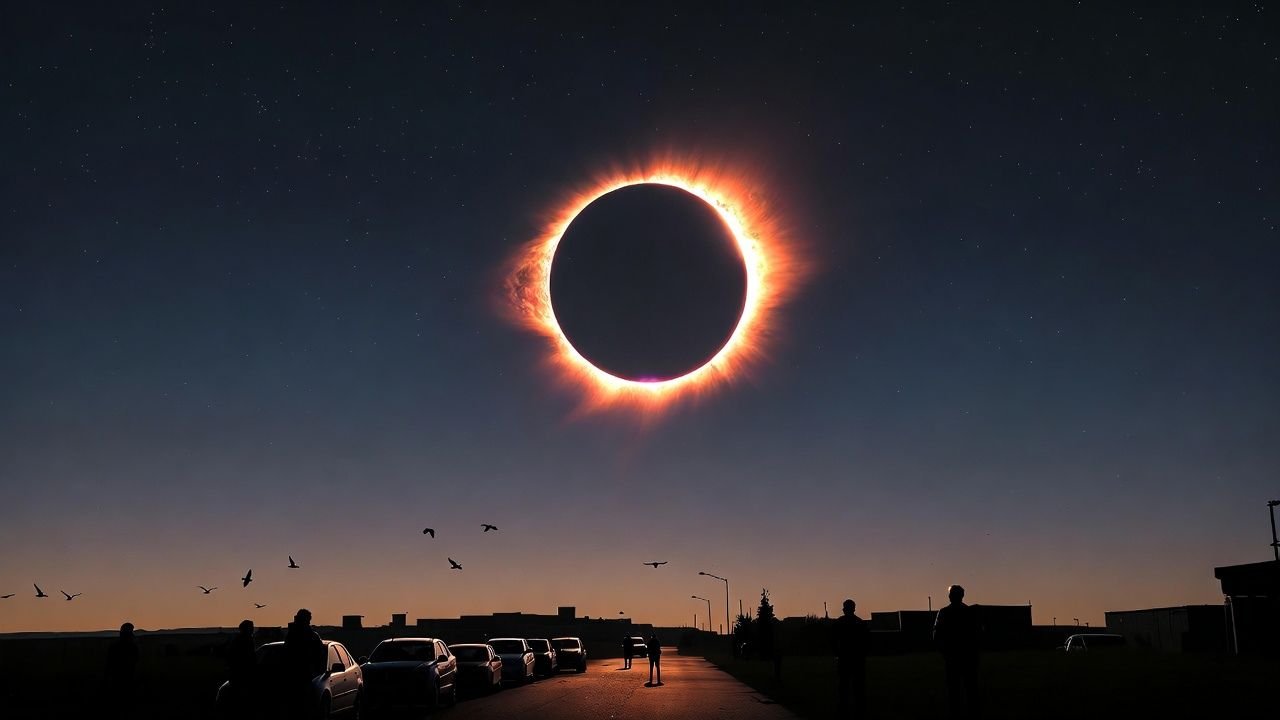
Car engines will still be running, doors will be half-open, children will be taking their last bites of ice cream—and then something strange will begin to happen in the sky. The sun will gradually thin, then transform into a luminous ring, and then it will seem as if it has completely disappeared. In its place will be a black disc, surrounded by a mysterious, fiery aura. The birds will fall silent, stars will twinkle in the middle of the day, and all the surrounding conversations will automatically fade into hushed whispers. This is not a scene from a movie or an ancient prophecy. This is a real astronomical event, whose date is already marked on the cosmic calendar—the longest total solar eclipse of the century. Astronomers have measured it down to the second, while we are still imagining what it will feel like when afternoon suddenly turns into night.
The Longest Solar Eclipse of the Century: What Makes It Special
This date is already marked with a red circle in observatories around the world. This upcoming total solar eclipse is extraordinary because the period of totality will be unusually long. In simple terms, the moon will cover the sun for so long that the day will truly feel “broken.” This won’t be a two- or four-second “wow” moment, but a still, profound, and strangely dark afternoon.
In the central path of the eclipse, the sun will be completely hidden for several minutes. The sky will become twilight-like, a drop in temperature will be felt, and shadows will appear unusually sharp and distinct. Those who have witnessed a total solar eclipse before say that the world’s sounds seem to be muted at that moment. This time, the experience will be even longer, so that silence may penetrate even deeper into the heart.
More Than Seven Minutes of Darkness: Why This is a Record
This record is not about how much of the sun will be covered, but about how long it will remain covered. In this event, the positions of the Sun, Moon, and Earth will be so precise that the Moon’s shadow will creep across the Earth’s surface. At its peak, totality could last for more than seven minutes. In the world of eclipses, this is practically an eternity—enough time to look around, take a deep breath, feel a little overwhelmed, and then compose yourself.
Most modern total solar eclipses offer only two or three minutes of darkness, and even those are incredibly intense experiences. The difference with this longer eclipse is like a flash of lightning versus a full song playing in the darkness. Such long eclipses are very rare, requiring the Earth’s orbit, the Moon’s distance, and the eclipse path to all be perfectly aligned. That’s why even seasoned astronomers are calling it a “once-in-a-lifetime experience.”
The Celestial Dance: Why This Eclipse Is So Special
On paper, the reason seems simple—the Moon passes between the Earth and the Sun. But behind this long eclipse lies a delicate balance of distance and size. The Sun is about 400 times larger than the Moon, but it’s also about 400 times farther away. This coincidence makes them appear almost the same size in the sky. When the Moon is closer to Earth in its elliptical orbit, it appears slightly larger than the Sun in the sky—large enough to completely cover it, and for a longer period.
This time, the Moon will be near its closest point to Earth. This will make its apparent size larger in the sky and extend the duration of totality. The Earth’s curvature and rotation will also stretch the experience in some locations. It will seem as if the geometry of the solar system has aligned in our favor for this one occasion.
Cities in the Path and Preparations for the Sky Show
The narrow path of the total solar eclipse—known as the “path of totality”—will pass over several areas already buzzing with anticipation. Small towns, usually quiet, will suddenly find themselves on the global map. Hotels, roads, and open fields will all be packed. The sky will transform these locations into the center of the world for a few minutes.
How to Truly Experience It, Not Just Witness It
If you want to experience this eclipse as a full event, not just a fleeting glimpse, a little planning is necessary. No elaborate preparations—just common sense. The most important thing is to be within the path of totality. Outside of it, you’ll see a partial eclipse, which is beautiful, but not the life-changing experience of totality. Astronomers emphasize this: it’s either totality or nothing.
Maps will be available months in advance. This will give you time to plan your trip to the path of totality. Check weather patterns, choose your location, and book early. Long eclipses attract people called “eclipse chasers,” who travel across continents just for a few minutes of darkness.
Eye Safety and the Reality of the Experience
Looking directly at the sun is dangerous, no matter how dim it may appear. Regular sunglasses are useless. Certified eclipse glasses or solar filters are essential. Only during the moment when the sun is completely covered can you look without protection. As soon as even a sliver of light returns, you must put your glasses back on. This isn’t an everyday habit, so setting a small reminder on your phone would be wise.
Many people think they’ll record it on their phones, but later realize the feeling is lost. Do the opposite with this eclipse—experience it first, record it later. Cameras can’t handle the extreme contrast properly. It’s better to immerse yourself in the changing light, the cooling temperature, the sounds, and theFeel the silence of the crowds and the emotions rising within you. Memories are made of feelings, not pixels.
Common Mistakes and How to Avoid Them
Many people underestimate the traffic and arrive late. Some forget that the magic happens not just during totality, but also immediately before and after, when the light bends in strange ways. Fumbling with cameras, filters, and settings can cause you to miss the moment. So scout the location the day before, have a pair of eclipse glasses for everyone, and have a “low-tech” plan—just your eyes, your senses, and your memory.
A Shared Shadow That Will Be Remembered for Years
The longest solar eclipse of the century is more than just an astronomical event. It’s a date that quietly alters people’s calendars, travel plans, and dreams. Some will take time off work to stand in an open field, while others will step outside to take out the trash and be startled by what they see above. The stories will be different, but the sky will be the same.
Even after the shadow passes, the feeling will remain that we witnessed reality “malfunction” in broad daylight. It reminds us how fragile what we take for granted is—the light, the warmth, the blue sky. Some will forget and return to their routines, and some will immediately begin searching for the date of the next great eclipse, as if hoping for another encounter with the sky.
Whether you travel for it or read about it afterward, this eclipse is going to be part of this century’s memories—a day when midday turned to night, the sun became a ring of fire, and the whole world looked in the same direction for a few minutes.